Close Menu
    What's Hot

    Beacon CRM Database Breach: Full Theft Confirmed

    August 13, 2026

    GitLab 19.2.2 Security Update: Critical Flaws Fixed

    August 13, 2026

    NESA Compliance UAE: Critical Controls

    August 13, 2026

    Chrome VPN Extensions: 737 Risky Add-ons Exposed

    August 12, 2026

    Critical SharePoint Vulnerability CVE-2026-63520 Hits 2026

    August 12, 2026
    Facebook X (Twitter) Instagram
    Friday, August 14
    CyberNexora News
    X (Twitter) Instagram LinkedIn
    • Home
    • Cyber Incidents
    • laws & government
    • Penalties
    • Learn & Protect
    • Resources
    • Contact Us
    Get Cyber Alerts
    CyberNexora News
    Home»laws & government»CERT-In Cyber Security Directions (2022): Why They Still Matter in 2026 and What Organizations Must Comply With

    CERT-In Cyber Security Directions (2022): Why They Still Matter in 2026 and What Organizations Must Comply With

    Zeel_CyberexpertBy Zeel_CyberexpertFebruary 11, 2026Updated:March 4, 20263 Mins Read
    Facebook Twitter LinkedIn Email Telegram

    Why This Matters in 2026

    Many organizations still believe that the CERT-In Cyber Security Directions, 2022 are outdated because of the year mentioned in the title.
    This is incorrect.

    The year 2022 only refers to the notification date, not validity.
    As of 2026, these directions are fully active, legally binding, and enforced under the Information Technology Act, 2000.

    πŸ”— Official CERT-In Notification (Primary Proof)
    https://www.cert-in.org.in/PDF/CERT-In_Directions_70B_28.04.2022.pdf

    Are CERT-In Directions Still Applicable in 2026?

    Yes. 100% applicable.

    • No expiry date is mentioned in the notification
    • No withdrawal or replacement has been issued by CERT-In or MeitY
    • CERT-In continues to reference these directions officially

    πŸ”— CERT-In Official Website
    https://www.cert-in.org.in/

    πŸ‘‰ This makes the directions current compliance requirements, not historical rules.

    Who Must Follow CERT-In Directions (2026)

    As per the official document, the following must comply:

    • Companies & body corporates
    • Cloud service providers
    • VPS & hosting providers
    • Data centres
    • VPN providers
    • Intermediaries & platforms
    • Virtual asset service providers
    • Government organizations

    πŸ”— Scope Defined by CERT-In (Official PDF)
    https://www.cert-in.org.in/PDF/CERT-In_Directions_70B_28.04.2022.pdf

    CERT-In 6-Hour Incident Reporting Rule (Explained)

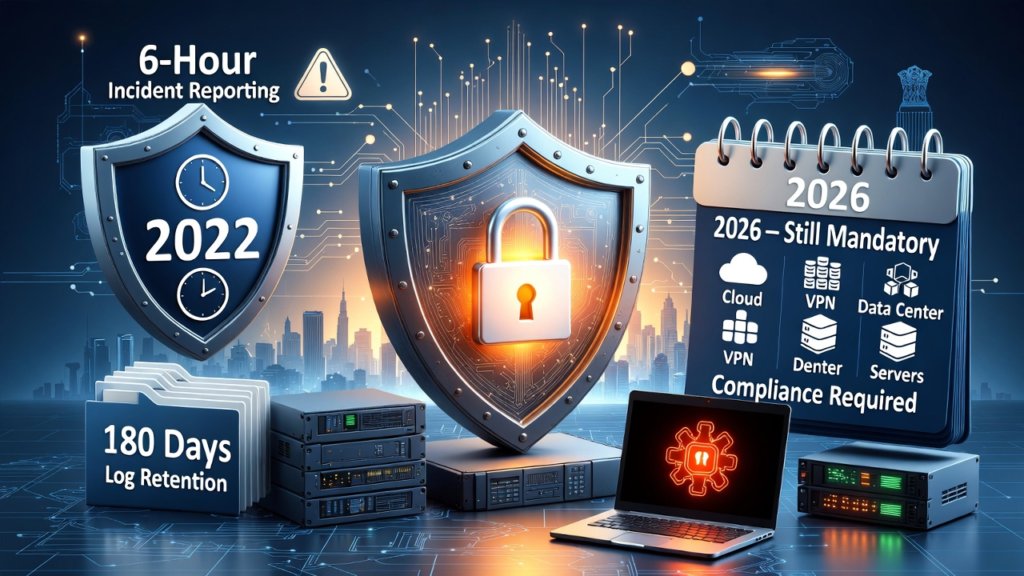
    Organizations must report specific cyber incidents within 6 hours of detection or notification.

    Reportable incidents include:

    • Data breach or data leak
    • Ransomware or malware attacks
    • Unauthorized system access
    • DDoS attacks
    • Phishing & identity theft
    • Attacks on cloud, IoT, mobile apps

    πŸ”— Annex-I – Official Incident List
    https://www.cert-in.org.in/PDF/CERT-In_Directions_70B_28.04.2022.pdf

    πŸ”— CERT-In Incident Reporting Portal
    https://www.cert-in.org.in/

    πŸ“§ incident@cert-in.org.in
    πŸ“ž 1800-11-4949

    Log Retention Rule – 180 Days (India Only)

    All organizations must:

    • Enable system logs
    • Retain logs for 180 days
    • Store logs inside India
    • Share logs with CERT-In when requested

    πŸ”— Log Retention Rule – Official Proof
    https://www.cert-in.org.in/PDF/CERT-In_Directions_70B_28.04.2022.pdf

    This applies to servers, firewalls, authentication systems, DNS, email, and applications.

    Time Synchronization Requirement (NTP Rule)

    ICT systems must sync time with:

    • NIC (National Informatics Centre) servers
    • NPL (National Physical Laboratory)
    • Or traceable equivalent sources

    πŸ”— Time Sync Rule – Official Source
    https://www.cert-in.org.in/PDF/CERT-In_Directions_70B_28.04.2022.pdf

    Accurate timestamps are critical for cyber-incident investigations.

    Cloud, VPS & VPN Data Retention – 5 Years

    Cloud, VPS, VPN, and data-centre providers must maintain:

    • Verified customer identity
    • IP address allocation records
    • Usage timestamps
    • Contact & ownership details

    Retention period:

    • Minimum 5 years, even after service termination

    πŸ”— Data Retention Clause – Official Proof
    https://www.cert-in.org.in/PDF/CERT-In_Directions_70B_28.04.2022.pdf

    Point of Contact (PoC) Requirement

    Every organization must appoint a Point of Contact (PoC) for CERT-In coordination.

    πŸ”— Annex-II – PoC Format (Official)
    https://www.cert-in.org.in/PDF/CERT-In_Directions_70B_28.04.2022.pdf

    Penalties for Non-Compliance

    Failure to follow CERT-In directions can lead to:

    • Legal action under Section 70B(7) of the IT Act
    • Regulatory scrutiny
    • Investigation delays
    • Reputational damage

    πŸ”— CERT-In FAQs (Official Clarifications)
    https://www.cert-in.org.in/PDF/FAQs_on_CyberSecurityDirections_May2022.pdf

    Related Articles

  • CERT-In Cybersecurity Guidelines Gain Industry Support Introduction: CERT-In Cybersecurity Guidelines β€” Why It Matters India’s newly...
  • Illuminate Education Data Breach 2026: FTC Finalizes Settlement Introduction: Illuminate Education Data Breach 2026 β€” Why It Matters...
  • Cloud Security 2026: Why It’s the Most Critical Cybersecurity Skill Today and for the Future Over the last few years, the technology landscape has changed...
  • What is HIPAA? Complete Guide to Healthcare Data Privacy and Compliance In an age where digital systems handle vast amounts of...
  • Seasonal File Scams in India: Why Ordinary Files Are Becoming a Silent Cyber Threat Cybercriminals in India carefully choose file names that feel routine...
  • Share. Facebook Twitter LinkedIn Email Telegram

    latest news

    Beacon CRM Database Breach: Full Theft Confirmed

    August 13, 2026

    GitLab 19.2.2 Security Update: Critical Flaws Fixed

    August 13, 2026

    NESA Compliance UAE: Critical Controls

    August 13, 2026

    Chrome VPN Extensions: 737 Risky Add-ons Exposed

    August 12, 2026

    Critical SharePoint Vulnerability CVE-2026-63520 Hits 2026

    August 12, 2026

    DESC ISR Compliance Dubai: Critical Guide

    August 12, 2026

    Mozilla Firefox Signing Key: Critical Revocation

    August 11, 2026

    OpenAI Daybreak Cyber: GPT-5.6-Cyber Unveiled

    August 11, 2026

    Dubai ISR Compliance Testing: The Annual Pentest Rules Explained

    August 11, 2026

    HP ThinPro TPM Flaw: Major LUKS Encryption Risk

    August 10, 2026
    Recent Posts
    • Beacon CRM Database Breach: Full Theft Confirmed
    • GitLab 19.2.2 Security Update: Critical Flaws Fixed
    • NESA Compliance UAE: Critical Controls
    Top Posts

    Unauthorized Access Incident at Coupang Exposes Customer Data

    December 29, 2025

    Significant Data Breach at Korean Air Subcontractor Exposes Employee Records

    December 29, 2025

    Beacon CRM Database Breach: Full Theft Confirmed

    August 13, 2026
    About

    CyberNexora Blog provides trusted cybersecurity news, attack analysis, and security awareness updates. Our goal is to educate and inform readers about emerging cyber threats and best protection practices.

    Facebook X (Twitter) Instagram Pinterest LinkedIn
    Pages
    • Home
    • Cyber Incidents
    • laws & government
    • Penalties
    • Learn & Protect
    • Resources
    • Contact Us

    Get Cyber Security Alerts

    Thanks! Please check your email to confirm subscription.

    • About CyberNexora News
    • Privacy Policy
    © 2026 CyberNexora News. All Rights Reserved.

    Type above and press Enter to search. Press Esc to cancel.