
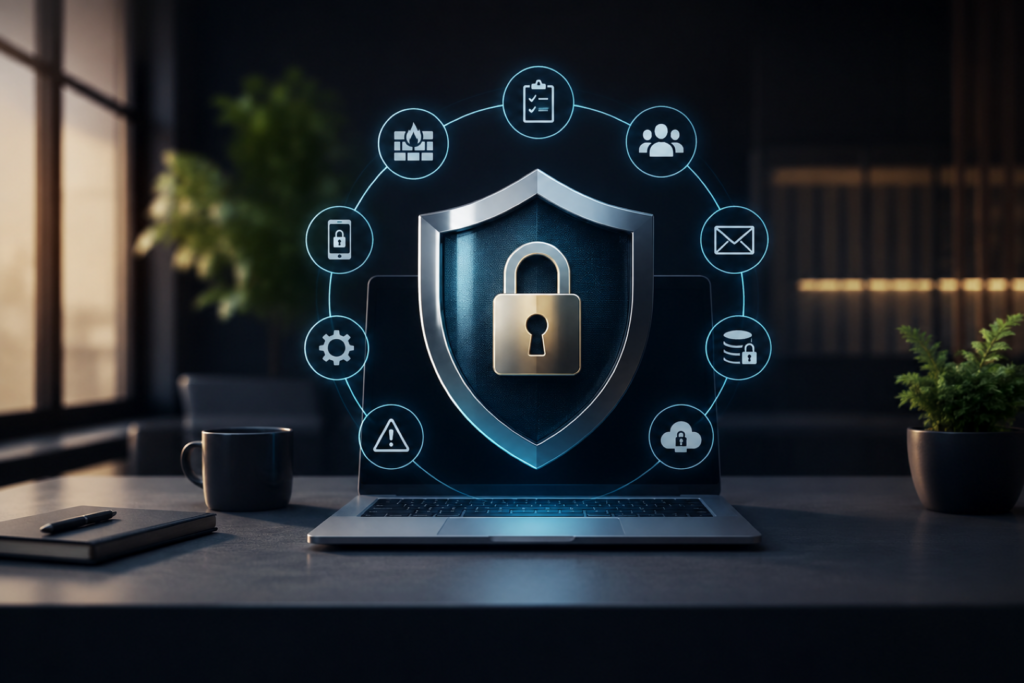
Introduction: Cybersecurity Checklist for Indian Businesses — Why It Matters
The Cybersecurity Checklist for Indian Businesses has become essential as cyberattacks are no longer limited to large enterprises. Today, businesses of every size face threats ranging from ransomware and phishing campaigns to business email compromise (BEC), insider attacks, and software supply chain compromises. As organizations continue to embrace cloud services, remote work, and digital transformation, strengthening cyber resilience has become a business necessity rather than an IT recommendation.
A comprehensive Cybersecurity Checklist for Indian Businesses helps organizations reduce security risks, protect sensitive data, and comply with evolving regulatory requirements. Whether you operate a startup, SME, or large enterprise, following these security best practices can significantly improve your ability to prevent, detect, and respond to cyber threats.
Why Every Business Needs the Cybersecurity Checklist for Indian Businesses
India has witnessed a steady rise in cyber incidents affecting government agencies, financial institutions, healthcare organizations, educational institutions, and private enterprises. Attackers increasingly exploit weak passwords, outdated software, misconfigured cloud services, and human error to gain unauthorized access.
Apart from financial losses, cyber incidents may result in:
- Operational disruption
- Loss of customer trust
- Legal and regulatory consequences
- Intellectual property theft
- Business reputation damage
Organizations should treat Cybersecurity Checklist for Indian Businesses as an ongoing risk management process by following internationally recognized frameworks such as the NIST Cybersecurity Framework rather than relying on one-time security implementations.
Cybersecurity Checklist for Indian Businesses: 30 Essential Security Measures
1. Enable Multi-Factor Authentication (MFA)
Protect every business account using MFA. Even if passwords are compromised, MFA significantly reduces unauthorized access attempts.
2. Enforce Strong Password Policies
Require long, unique passwords and prohibit password reuse. Implement password managers for employees to securely store credentials.
3. Keep Systems Updated
Regularly install security patches for operating systems, applications, servers, firmware, and network devices to close known vulnerabilities.
4. Deploy Endpoint Protection
Install advanced endpoint security solutions capable of detecting malware, ransomware, spyware, and suspicious behavior across all corporate devices.
5. Secure Business Email
Use email filtering, anti-phishing technologies, SPF, DKIM, and DMARC to reduce phishing and Business Email Compromise (BEC) attacks.
6. Configure Enterprise Firewalls
Deploy properly configured firewalls to monitor and control inbound and outbound network traffic while blocking unauthorized access.
7. Perform Regular Data Backups
Maintain secure offline and cloud backups of critical business data and routinely verify that recovery procedures work as expected.
8. Test Disaster Recovery Plans
Conduct recovery drills to ensure critical operations can be restored quickly after ransomware or system failures.
9. Encrypt Sensitive Data
Protect customer, employee, and financial information using encryption both during transmission and while stored.
10. Apply the Principle of Least Privilege
Grant employees only the access necessary for their responsibilities and review permissions periodically.
11. Monitor User Accounts
Disable inactive accounts immediately and remove unnecessary administrator privileges.
12. Conduct Vulnerability Assessments
Regularly scan systems to identify outdated software, insecure configurations, and exploitable vulnerabilities before attackers discover them.
13. Perform Penetration Testing
Simulate real-world attacks to evaluate existing security controls and uncover weaknesses that automated scans may miss.
14. Monitor Network Activity
Implement continuous logging and network monitoring to identify unusual behavior, suspicious logins, and potential intrusions.
15. Deploy Security Information and Event Management (SIEM)
Centralize security logs to improve threat detection, incident investigation, and compliance reporting.
16. Protect Cloud Infrastructure
Review cloud security settings regularly and secure storage buckets, virtual machines, APIs, and identity management configurations.
17. Secure Remote Access
Require VPNs, MFA, and encrypted connections for employees accessing business systems remotely.
18. Train Employees Regularly
Conduct cybersecurity awareness sessions covering phishing, social engineering, password hygiene, and safe internet practices.
19. Run Phishing Simulations
Evaluate employee readiness through simulated phishing campaigns and provide additional training where needed.
20. Assess Third-Party Vendors
Evaluate vendors, contractors, and supply chain partners before granting access to business systems or sensitive information.
21. Review Software Supply Chain Risks
Use trusted software sources and verify updates to minimize the risk of compromised software components.
22. Segment Business Networks
Separate critical servers, production environments, and employee networks to reduce lateral movement during attacks.
23. Secure Wireless Networks
Use WPA3 encryption, strong authentication, and separate guest Wi-Fi from corporate infrastructure.
24. Protect Mobile Devices
Implement Mobile Device Management (MDM), encryption, and remote wipe capabilities for business smartphones and tablets.
25. Establish an Incident Response Plan
Document procedures for detecting, containing, investigating, and recovering from cyber incidents.
26. Conduct Incident Response Exercises
Test incident response plans regularly through tabletop exercises and simulated cyberattack scenarios.
27. Maintain Asset Inventory
Keep an updated inventory of hardware, software, cloud resources, and connected devices to improve visibility.
28. Comply with CERT-In Requirements
Organizations operating in India should retain security logs for 180 days and report specified cyber incidents to CERT-In within six hours of detection in accordance with applicable directions.
29. Review Security Policies Regularly
Update cybersecurity policies to reflect new technologies, evolving threats, business changes, and regulatory requirements.
30. Continuously Improve Cybersecurity
Cybersecurity is an ongoing process. Regular audits, employee training, security assessments, and technology upgrades help organizations remain resilient against emerging threats.
Industry Perspective
The Cybersecurity Checklist for Indian Businesses becomes increasingly important as attackers adopt artificial intelligence, automation, and sophisticated social engineering techniques. Ransomware groups, phishing campaigns, and supply chain compromises remain among the most significant threats facing organizations worldwide.
Businesses should regularly review their Cybersecurity Checklist for Indian Businesses while monitoring reliable cybersecurity resources to stay prepared for emerging threats. Readers can also explore CyberNexora News’ Learn & Protect, Cyber Incidents, and Laws & Government categories for additional guidance on emerging cyber risks, regulatory updates, and security best practices.
Key Takeaways
- Enable Multi-Factor Authentication across all business accounts.
- Keep systems updated with the latest security patches.
- Conduct regular vulnerability assessments and penetration testing.
- Train employees to recognize phishing and social engineering attacks.
- Secure third-party vendors and software supply chains.
- Monitor systems continuously for suspicious activity.
- Back up business-critical data and test recovery procedures.
- Follow the Cybersecurity Checklist for Indian Businesses to maintain CERT-In compliance and strengthen cyber resilience.
- Review cybersecurity policies regularly to address evolving threats.
- Treat cybersecurity as a continuous business process rather than a one-time project.
Conclusion: Cybersecurity Checklist for Indian Businesses and What Comes Next
Following a structured Cybersecurity Checklist for Indian Businesses helps organizations build stronger defenses against today’s rapidly evolving threat landscape. While no security program can eliminate every risk, implementing layered security controls significantly reduces the likelihood and impact of cyber incidents.
As cyber threats continue to evolve, organizations should regularly review their Cybersecurity Checklist for Indian Businesses to strengthen security posture and adapt to emerging attack techniques. A proactive cybersecurity strategy remains one of the most effective investments any business can make.
Frequently Asked Questions(FAQs)
The Cybersecurity Checklist for Indian Businesses is a collection of essential security practices designed to help organizations protect their systems, customer data, and business operations from cyber threats. It includes technical controls, employee awareness, regulatory compliance, and incident response planning.
Cybersecurity protects organizations from ransomware, phishing, business email compromise (BEC), insider threats, and data breaches. A strong security posture also helps maintain customer trust, business continuity, and regulatory compliance.
Every business should enable Multi-Factor Authentication (MFA), keep systems updated, deploy endpoint protection, perform regular backups, encrypt sensitive data, conduct vulnerability assessments, and train employees to recognize phishing attacks.
CERT-In requires organizations covered by its directions to retain ICT system logs for 180 days and report specified cybersecurity incidents within six hours of becoming aware of them. Businesses should review the latest CERT-In directions to ensure ongoing compliance.
Organizations should conduct vulnerability assessments regularly, particularly after infrastructure changes or software updates. Penetration testing should be performed periodically or whenever significant changes are made to business-critical systems.
Yes. Small businesses are increasingly targeted because attackers often view them as having weaker defenses. Implementing a cybersecurity checklist significantly reduces the likelihood of successful attacks while improving operational resilience.