
Introduction: AI Emotion Recognition Trend — Why It Matters
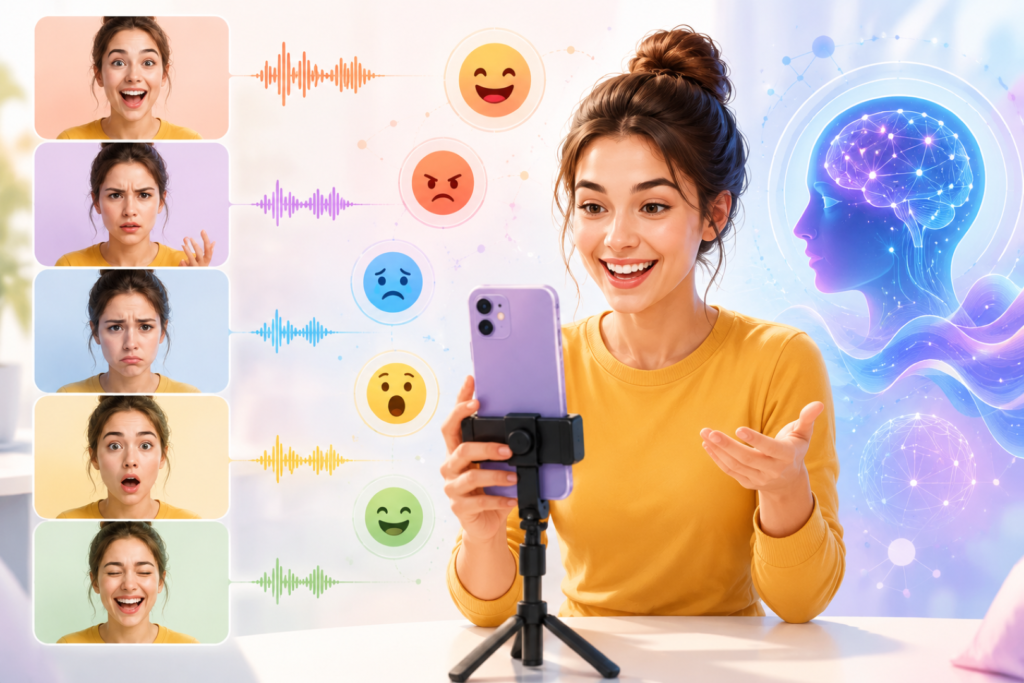
The AI Emotion Recognition Trend has become one of the latest viral phenomena across social media platforms, with users recording themselves repeating the same phrase while expressing different emotions such as happiness, anger, sadness, sarcasm, and excitement.
While the trend appears harmless and entertaining, experts interviewed by Cybernews have suggested that the AI Emotion Recognition Trend could inadvertently provide valuable training data for artificial intelligence systems. Researchers say emotional speech remains one of the most difficult areas for AI to understand accurately, making these videos potentially useful for future AI development.
The discussion has sparked broader concerns about privacy, surveillance, and how publicly shared emotional data may be used in the future.
What Caused the Concern?
The viral challenge encourages users to say identical phrases repeatedly while changing only their tone of voice and facial expression.
For AI developers, this creates a highly structured dataset containing:
- The same words spoken with different emotions
- Consistent speech patterns
- Variations in vocal tone
- Facial expression changes
- Contextual emotional cues
According to experts cited by Cybernews, such data could help improve AI systems designed to analyze human emotions and sentiment.
AI Emotion Recognition Trend: Full Technical Breakdown
Timeline of Events
- Social media users began posting videos using identical phrases delivered in different emotional tones.
- The trend rapidly spread across platforms including short-form video networks.
- Technology researchers and digital ethicists began discussing the potential AI implications.
- Privacy advocates raised concerns about emotional data collection and future surveillance applications.
How AI Could Benefit From the Trend
Researchers note that emotion recognition remains a major challenge for AI systems.
Current limitations include:
- Difficulty detecting sarcasm
- Misinterpreting emotional context
- Struggling with cultural differences
- Limited understanding of subtle emotional cues
- Inconsistent sentiment analysis results
The large volume of publicly available videos generated by this trend may provide examples that help improve:
- Speech recognition systems
- Virtual assistants
- Customer service chatbots
- Call center analytics
- Sentiment analysis platforms
- Human-computer interaction technologies
Potential Risks & Impact
Privacy Risk
The AI Emotion Recognition Trend has raised concerns that users may unknowingly provide detailed emotional and behavioral information through publicly accessible videos. Organizations are increasingly looking to frameworks such as the NIST AI Risk Management Framework to address transparency, accountability, and privacy risks associated with emerging AI technologies.
Unlike traditional personal information, emotional data can reveal:
- Stress levels
- Mood patterns
- Communication habits
- Behavioral tendencies
- Psychological indicators
Workplace Surveillance Risk
One of the most significant concerns involves emotional AI in professional environments.
The Institute for the Future of Work (IFOW) has previously highlighted concerns surrounding workplace monitoring technologies that attempt to evaluate employee emotions and engagement levels using AI systems.
Such technologies could potentially be used to:
- Monitor employee sentiment
- Measure workplace engagement
- Analyze customer interactions
- Evaluate communication performance
Regulatory and Ethical Risk
Many countries currently lack specific regulations governing emotional AI technologies.
This creates uncertainty regarding:
- Consent requirements
- Data ownership
- Emotional profiling
- AI transparency
- Algorithmic accountability
Official Response / Statement
As the AI Emotion Recognition Trend continues to gain popularity, no specific technology company has publicly stated that it is collecting or using data from this viral trend for AI training purposes.
However, AI researchers interviewed by Cybernews emphasized that publicly shared content often becomes valuable for understanding human communication patterns and improving machine-learning models.
Privacy experts have therefore encouraged users to remain aware of how publicly available content may be analyzed in the future.
Industry Context: Why Emotional AI Is Growing
The growing attention surrounding the AI Emotion Recognition Trend reflects broader efforts to improve emotional AI capabilities to make artificial intelligence systems more human-aware.
Recent developments across the industry have focused on:
- Advanced sentiment analysis
- Voice recognition improvements
- Human-computer interaction
- Behavioral analytics
- AI-powered customer service
Readers interested in broader AI-related cybersecurity developments can also explore CyberNexora’s coverage of cyber incidents and Learn & Protect awareness guides.
The concerns surrounding emotional AI have also been highlighted by the Institute for the Future of Work’s Emotional AI research, which examines the impact of workplace monitoring technologies. As AI systems become increasingly integrated into workplaces, healthcare, education, and customer service, demand for emotion recognition capabilities continues to grow.
How to Protect Yourself
Users concerned about emotional AI and privacy risks can take several practical steps:
- Review privacy settings on social media platforms.
- Limit public visibility of personal videos when possible.
- Understand platform data usage policies.
- Avoid sharing sensitive personal information alongside viral content.
- Regularly monitor account privacy controls.
- Stay informed about emerging AI technologies and surveillance concerns.
- Read trusted cybersecurity awareness resources before participating in data-intensive online trends.
Additional guidance can be found through CyberNexora’s Learn & Protect section and Resources category.
Key Takeaways
- A viral social media challenge involves repeating the same phrase using different emotional tones.
- Experts say the content could be useful for improving AI emotion recognition systems.
- Emotional AI remains a difficult area for machine-learning models.
- Privacy advocates warn that emotional data may contribute to future surveillance concerns.
- No major technology company has publicly confirmed using this specific trend for AI training.
Conclusion: AI Emotion Recognition Trend and What Happens Next
The AI Emotion Recognition Trend highlights the growing intersection between social media behavior and artificial intelligence development. While the challenge is primarily viewed as entertainment, experts argue that publicly shared emotional speech data may have value far beyond its original purpose.
The AI Emotion Recognition Trend highlights the growing intersection between social media behavior and artificial intelligence development. As the AI Emotion Recognition Trend continues spreading across platforms, experts expect further debate about privacy and data usage. As emotional AI technologies continue to evolve, regulators, researchers, and privacy advocates will likely pay closer attention to how emotional data is collected, processed, and used. Readers should continue monitoring developments in AI governance, privacy protections, and emerging digital surveillance practices through CyberNexora’s Laws & Government coverage.
Frequently Asked Questions(FAQs)
The AI Emotion Recognition Trend is a viral social media challenge where users repeat the same phrase while expressing different emotions. Experts believe the content may provide useful examples for AI systems learning emotional patterns.
Experts are concerned because emotional speech data can potentially improve AI emotion detection technologies. Some privacy advocates worry this could contribute to future surveillance capabilities.
Not completely. Modern AI systems still struggle with sarcasm, context, cultural differences, and subtle emotional expressions.
Yes. Some organizations use AI-powered analytics tools to evaluate customer interactions, employee engagement, and communication patterns, although practices vary widely.
There is no evidence that posting a video automatically trains a specific AI model. However, publicly available content can potentially be analyzed or incorporated into future research datasets depending on platform policies and permissions.